The short version
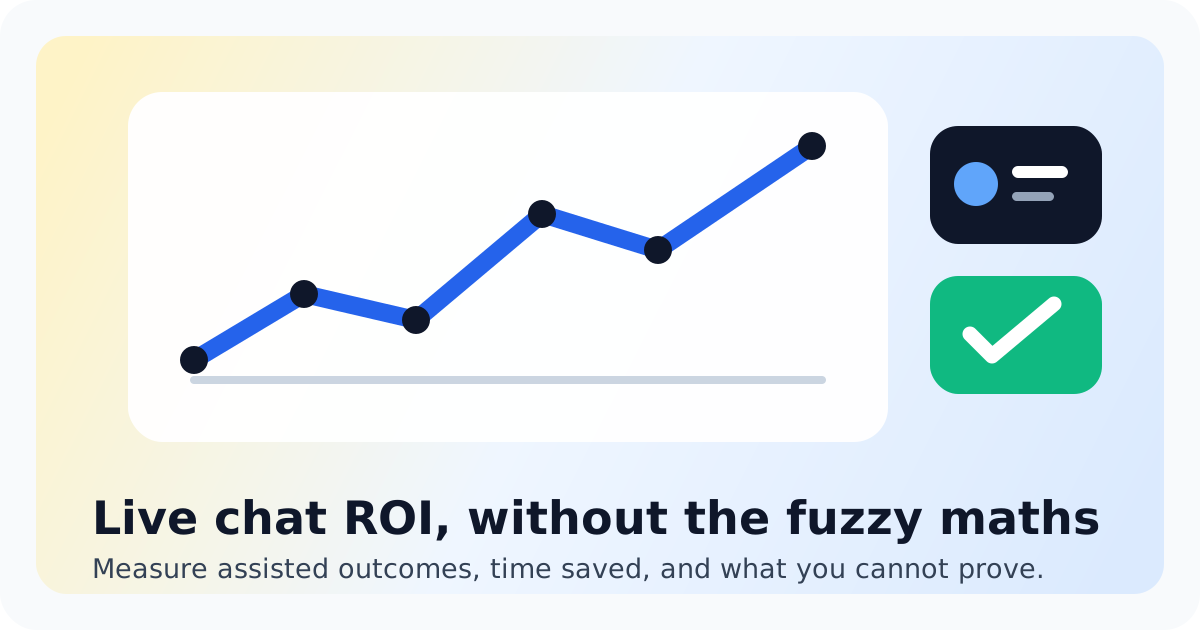
Live chat can create value in two different places: it can help a hesitant visitor complete a valuable action, and it can reduce the time your team spends handling repetitive support. Measure both, then subtract the real software and staffing cost.
- Track conversations against a shared visitor, lead, or order journey where your consent setup allows it.
- Separate assisted outcomes from outcomes merely observed after chat.
- Measure support time saved without assuming every template saves the same amount.
- Compare a stable period before and after the workflow change.
- Keep a short list of outcomes chat cannot prove.
Attribution should make a claim smaller and more trustworthy, not larger and more exciting.
Start by defining the job live chat is meant to do
A scorecard is useless when the team has not agreed on the job. One store may want chat to answer product questions before checkout. Another may want fewer repetitive emails. A service business may care about qualified consultations, not online orders.
- Conversion job: help qualified visitors reach checkout, signup, booking, or another meaningful next step.
- Support job: resolve questions faster with less team effort.
- Learning job: reveal missing product, policy, and page information.
- Coverage job: collect useful context when nobody is available live.
Pick one primary job and at most two secondary jobs for the first measurement period. Otherwise every metric becomes evidence of success and none of them can guide a decision.
Measure conversion value with a confidence ladder
Not every order after a conversation was caused by the conversation. Use levels of evidence instead of one oversized 'chat revenue' number.
- Observed: the same known visitor chatted and purchased within the defined window.
- Assisted: the conversation addressed a purchase condition, and the visitor later completed the matching outcome.
- Confirmed: the customer, agent, or controlled experiment provides direct evidence that the conversation changed the decision.
Report these levels separately. An observed order is useful evidence of association, but it is not proof that chat caused the order. Keep anonymous or unjoinable journeys outside attributed revenue rather than forcing a match.
Measure support value as time and work avoided
Support value is often easier for a small team to verify. Sample a set of common conversations and measure the handling time before and after saved replies, clearer pages, routing, or self-service improvements.
- Conversations resolved without another channel
- Median active handling time by contact reason
- Repeat contacts for the same issue
- Questions prevented after a page or policy fix
- After-hours messages that arrive with enough context for one-touch follow-up
Use median time rather than a simple average when a few complex cases distort the picture. Count prevented questions carefully: a drop is valuable only when demand and traffic are comparable and customers are still reaching the outcome they need.
Use a simple monthly formula
Start with a deliberately conservative model:
Confirmed contribution = confirmed assisted gross profit
Operational value = verified hours saved x realistic loaded hourly cost
Monthly net value = confirmed contribution + operational value - software cost - added staffing cost
ROI = monthly net value / total monthly chat cost x 100
Use gross profit rather than revenue when product costs are material. Do not count the same value twice, such as calling a quicker conversation both time saved and added labor capacity unless that capacity produced a separately measured outcome.
The small-team scorecard
| Category | Metric | What it tells you | Guardrail |
|---|---|---|---|
| First response time | Whether staffed coverage is responsive | Measure staffed and unstaffed hours separately | |
| Resolved in chat | Whether channel switching fell | Confirm the customer did not repeat the issue elsewhere | |
| Assisted outcomes | Whether chats appear in valuable journeys | Label association separately from causation | |
| Handling time | Whether the workflow reduces team effort | Compare the same contact reasons | |
| Repeat-question rate | Whether pages and policies are improving | Control for traffic and campaign mix |
Run a 30-day measurement cycle
- Week 0: record the baseline, costs, traffic, outcomes, and support workload.
- Week 1: launch with one primary job and consistent conversation tagging.
- Weeks 2 and 3: fix repeated page questions and review unmatched journeys.
- Week 4: compare like-for-like metrics and manually audit a sample of claimed outcomes.
- Decision day: keep, change, or remove the workflow based on net value and customer experience.
Document campaign changes, discounts, traffic spikes, outages, and staffing changes. If the period was not comparable, extend the test instead of manufacturing certainty.
What the numbers cannot prove on their own
- A purchase after chat does not prove chat caused it.
- More conversations do not prove customers received better help.
- A faster first response does not prove the issue was resolved.
- Fewer tickets do not prove success if customers simply gave up.
- An attributed transaction does not prove the promised service or product was fulfilled.
This is why journey data, conversation review, and fulfillment confirmation belong together. Good measurement connects the question, the response, the outcome, and what the customer actually received.
A note on the research approach
This scorecard follows Google's guidance to create people-first content with original analysis instead of repeating unsupported headline statistics. The formulas are a practical framework from Chatting, not a universal benchmark. Use your own margins, staffing cost, consent rules, customer journeys, and baseline.
FAQ
Measure conversations as part of the whole journey
Use Chatting to keep customer context and team replies together, then evaluate the outcomes with a conservative scorecard.
Start live chat freeRecommended next steps
Live chat software for small teams
live chat software for small teams
Live chat software for small teamsZendesk alternative
Switch to Chatting if the team mainly needs live chat, page context, and after-hours capture.
Zendesk alternativeLive Chat ROI Calculator
Plug in your monthly visitors, current conversion rate, and average order value to estimate the impact of faster conversations.
Live Chat ROI CalculatorA website chat widget for startups and small teams
website chat for startups
A website chat widget for startups and small teamsFAQ
What is a good live chat ROI?
There is no universal target. A positive, repeatable net value based on conservative inputs matters more than matching somebody else's benchmark.
Should I count all orders after chat?
No. Report observed, assisted, and confirmed outcomes separately, and exclude journeys you cannot reliably join.
How long should I measure?
Thirty days is a useful first cycle for an active site, but extend it when volume is low or the period contains unusual campaigns or operational changes.
Can live chat be worthwhile without direct sales?
Yes. Verified time saved, fewer repeat contacts, better after-hours context, and clearer pages can create measurable value without claiming direct revenue.