The short version
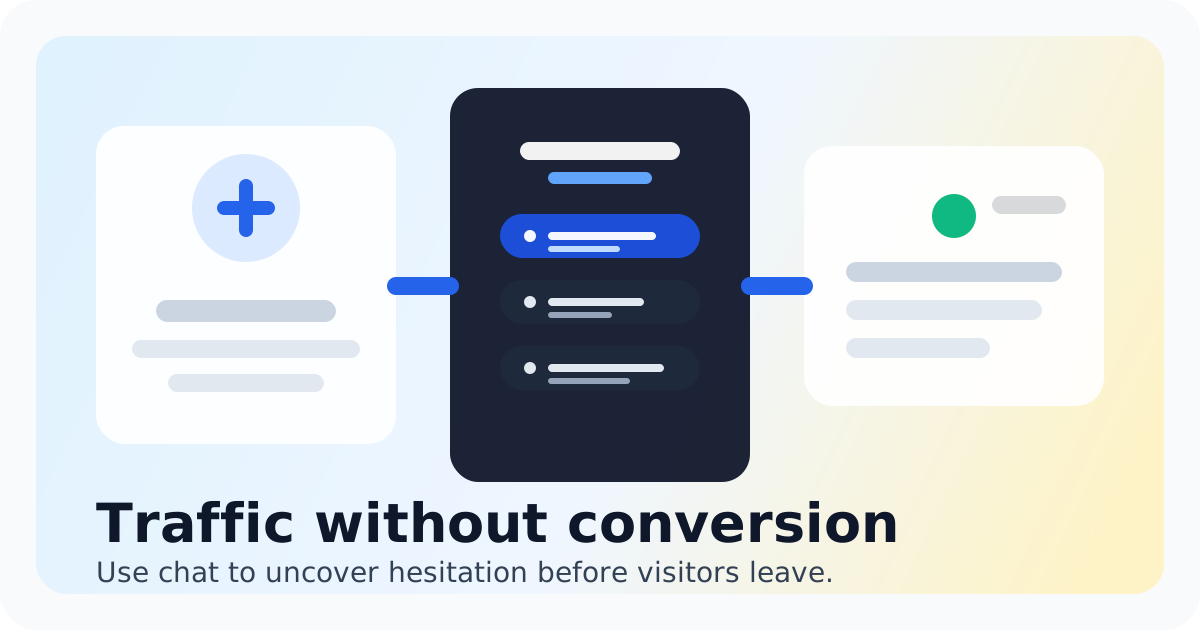
Getting traffic is not the same as getting results. A site can have a few hundred visits and no conversions, or a huge amount of traffic and a weak conversion rate, and the underlying problem is often the same: something in the journey is creating friction, confusion, or doubt.
- Check whether the promise that brought people in matches the page they land on.
- Make the value obvious in the first few seconds.
- Remove trust gaps around proof, pricing, timing, guarantees, or next steps.
- Use live chat to uncover hesitation while people are still on the site.
Analytics can tell you where people drop off. They usually cannot tell you why.
What low conversion usually means
When traffic is coming in but conversions stay weak, the problem usually falls into one of a few buckets: the wrong audience is arriving, the right audience is arriving but the page is not doing enough to convert them, the offer is interesting but trust is too weak, or visitors have simple questions and no easy way to get answers.
A lot of teams jump straight to blaming traffic. Sometimes that is correct. But plenty of low-converting sites have the opposite problem: the visits are real, the interest is real, and the page is where momentum breaks.
That is actually a better problem to have, because conversion problems are usually more fixable than demand problems.
What usually blocks the conversion
The same issues come up again and again across e-commerce stores, SaaS landing pages, local service businesses, agencies, and info-product offers.
- The value proposition is not clear enough.
- The page assumes too much prior understanding.
- The offer feels weak compared to the price.
- There is not enough proof, demonstration, or reassurance.
- The next step feels risky or unclear.
Different businesses, same core problem: the visitor is interested, but not convinced enough to act.
A simple case: traffic arrives, but the questions stay unresolved
A common pattern looks like this: a business starts running ads or getting traction from content. People click through. Some spend time on the page. Maybe a few even start the process. But the conversion rate stays weak.
At first, it looks like a traffic problem. Then you look closer and realize visitors are still trying to figure out basic things.
- Is this actually for me?
- Why should I trust this?
- What makes this different?
- What happens next?
- Can I get a quick answer before I commit?
Those are not impossible objections. They are just unresolved ones. Until the site resolves them, more traffic usually just means more wasted attention.
Why live chat helps when conversion is weak
This is where Chatting fits. If your site is getting traffic but not enough sales or leads, live chat is not just a support layer. It is a way to hear the objections your analytics cannot explain.
A lot of conversion problems are really question problems. Visitors are wondering whether the offer fits their situation, how the process works, what happens after they submit, or whether there is a catch. When nobody answers those questions, the visitor leaves.
Chatting gives small teams a cleaner way to catch that moment.
What Chatting helps you learn fast
For a business trying to improve conversion, the first value of live chat is not building a massive support workflow. It is learning faster.
- See what visitors ask before converting.
- Capture after-hours interest instead of losing it.
- Spot repeat objections across key pages.
- Follow up with interested people who are not ready yet.
- Use FAQ suggestions and live conversation to reduce hesitation.
That gives you better input for fixing page copy, offer clarity, FAQ content, pricing explanation, trust signals, call-to-action language, and the lead capture flow.
What to fix before spending more on traffic
If traffic is coming in but conversion is lagging, fix the page before scaling spend.
- Clearer positioning
- Stronger proof
- Better explanation of the offer
- Less friction around the next step
- More visible trust signals
- Faster answers to pre-conversion questions
Do not keep paying for more visits to a page that is already under-converting. That is not scale. That is expensive ambiguity.
Our take
If your site is getting traffic but not enough sales or leads, the answer is usually not just to get more traffic. It is to find the friction.
That is why Chatting is useful at this stage. It helps small teams uncover the questions, objections, and trust gaps that stop people from converting, and it gives visitors a way to ask instead of bounce.
Find what is blocking conversions faster
Use Chatting to surface buyer questions, capture after-hours interest, and turn low-converting traffic into clearer next actions for your team.
Start live chat freeFAQ
Is low conversion always a traffic problem?
No. Sometimes traffic quality is the issue, but often the bigger problem is that the page does not explain, reassure, or convert well enough.
Should I increase ad spend if conversion is weak?
Usually not yet. Fix the page, trust gaps, and buying friction first so you do not pay to learn slowly.
How does live chat help with conversion?
It helps you uncover real visitor objections in real time instead of guessing from bounce rate, scroll depth, and click-through data alone.
Is Chatting more useful for support or conversion?
For teams in this situation, it is often most useful as a pre-sales or pre-conversion learning tool first. The conversations tell you what the page still is not doing.
What should I look at first on a low-converting site?
Start with clarity, trust, pricing or offer support, and the questions visitors are most likely leaving with. Those are usually the fastest path to better conversion.
Recommended next steps
Live chat software for small teams
live chat software for small teams
Live chat software for small teamsIntercom alternative
Switch to Chatting if Intercom has become more software than your live-chat workflow needs.
Intercom alternativeLive Chat ROI Calculator
Plug in your monthly visitors, current conversion rate, and average order value to estimate the impact of faster conversations.
Live Chat ROI CalculatorA website chat widget for startups and small teams
website chat for startups
A website chat widget for startups and small teams